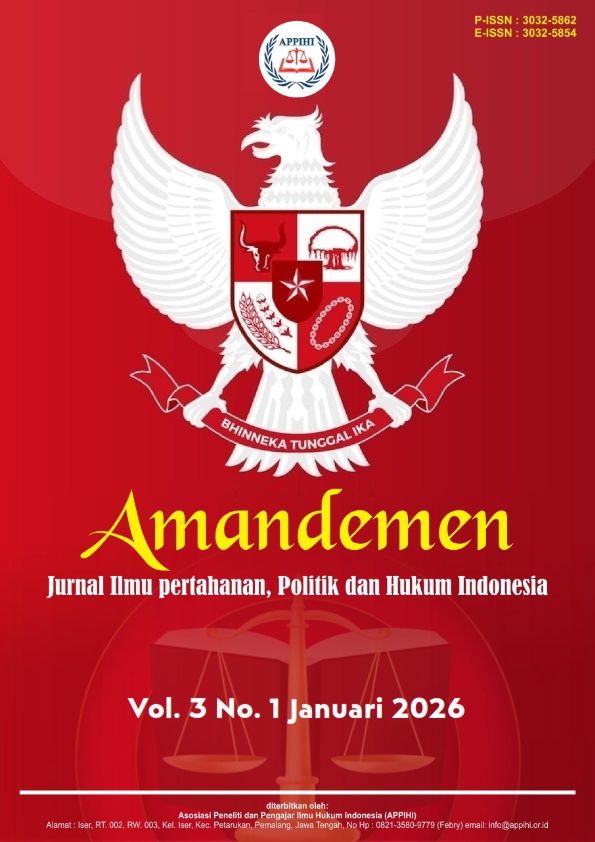
Courtesy Beyond Stereotypes: Sociological and Legal Sociological Insights into Iranian Society
DOI:
https://doi.org/10.62383/amandemen.v3i1.1613Keywords:
Cultural Sociology, Hospitality, Social Interaction, Social Norms, TaarofAbstract
This study examines the social realities of Iranian society, often misrepresented in international media that focus on politics, conflict, or conservatism. Using a sociological and humanistic perspective, it highlights everyday practices of courtesy, social norms, and traditions. The taarof ritual a unique form of politeness is discussed as a vivid example of how Iranians foster social harmony, respect guests, and demonstrate solidarity. The article also considers the impact of formal and customary law on social behavior, alongside the interplay between tradition and modernity in urban and rural contexts. Field observations and literature review suggest that Iranian society maintains high levels of courtesy and social cohesion, challenging common stereotypes. This research aims to enrich cross-cultural understanding and provide a more nuanced view of social life in Iran.
Downloads
References
Ahmady, K., et al. (2022). A house on water: Penelitian tentang pernikahan sementara dan dinamika sosial di Iran. LAP Lambert Academic Publishing.
Amanat, A. (2017). Iran: A modern history. Yale University Press. https://doi.org/10.2307/j.ctv19prrqm
Axworthy, M. (2007). Iran: Empire of the mind: A history from Zoroaster to the present day. Hurst.
Beeman, W. O. (2004). Language, status, and power in Iran. Indiana University Press.
Gohari Sadr, N., Heidariasl, S., Megerdoomian, K., Seyyed Kalantari, L., & Emami, A. (2025). We politely insist: Your LLM must learn the Persian art of taarof. arXiv. https://doi.org/10.18653/v1/2025.emnlp-main.94
Golkar, S. (2015). Captive society: The Basij militia and social control in Iran. Woodrow Wilson Center Press & Columbia University Press. https://doi.org/10.7312/golk70442
Islamic beliefs and host guest relationships in Iran. (2020). International Journal of Hospitality Management, 90, 102603. https://doi.org/10.1016/j.ijhm.2020.102603
Karimi, P. (2017). Domesticity and consumer culture in Iran: Interior revolutions of the modern era. Oxford University Press.
Kian, A. (2023). Rethinking gender, ethnicity and religion in Iran. I.B. Tauris. https://doi.org/10.5040/9780755650286
Koutlaki, S. A. (2002). Offers and expressions of thanks as face-enhancing acts: A study of taʿārof in Persian. Journal of Pragmatics, 34(12). https://doi.org/10.1016/S0378-2166(01)00055-8
Matthee, R. P. (2005). The pursuit of pleasure: Drugs and stimulants in Iranian history, 1500-1900. Princeton University Press. https://doi.org/10.1515/9781400832606
Mottahedeh, R. (2009). The mantle of the prophet: Religion and politics in Iran. OneWorld.
Nafisi, A. (2003). Reading Lolita in Tehran: A memoir in books. Random House.
Nejad, S. A. H. (2015). Prinsip-prinsip hukum dan hak keluarga dalam fikih Jaʿfari & sistem syar'i Republik Islam Iran. Musãwa: Jurnal Studi Gender dan Islam, 14(1). https://doi.org/10.14421/musawa.2015.141.1-10
Özalp, A. (2024). The concept of "living law" in the sociology of Eugen Ehrlich. Journal of Eskişehir Osmangazi University Faculty of Theology, 11(1). https://doi.org/10.51702/esoguifd.1380652
Pollack, K. (2012). The Persian puzzle: The conflict between Iran and America. Random House.
Saffari, H., Shafiei, M., & Pierri, F. (2024). PSN: Persian social norms dataset for cross-cultural AI.
Yarbakhsh, E. (2021). Iranian hospitality, Afghan marginality: Spaces of refuge and belonging in the city of Shiraz. Lexington Books. https://doi.org/10.5040/9781666995442
Downloads
Published
How to Cite
Issue
Section
License
Copyright (c) 2026 Amandemen: Jurnal Ilmu pertahanan, Politik dan Hukum Indonesia

This work is licensed under a Creative Commons Attribution-ShareAlike 4.0 International License.